
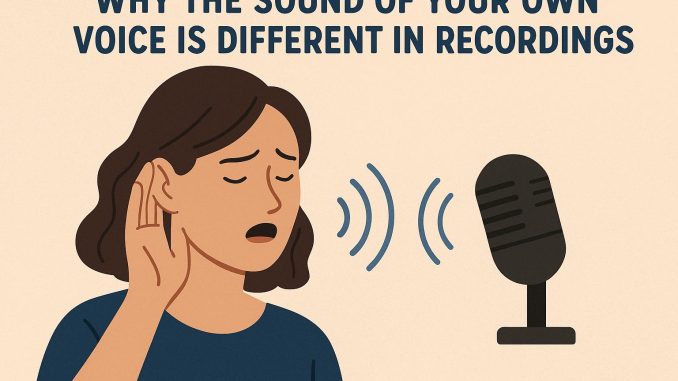
The Phenomenon of Hearing Your Own Voice Differently
Listening to a recording of your own voice often leads to a surprising revelation of how different it sounds compared to when you speak. This common experience is rooted in the distinct ways sound is transmitted to your ears when speaking versus when listening to a recording.
Sound Transmission: Bone Conduction vs. Air Conduction
When you speak, the sound waves you produce travel to your inner ear through two pathways: air conduction and bone conduction.
Air conduction is the process by which sound waves travel through the air, entering the outer ear and vibrating the eardrum. This pathway is used when you listen to any external sounds, including your recorded voice.
Conversely, bone conduction involves the transmission of sound vibrations through the bones of your skull directly to the inner ear. When you speak, these vibrations are mixed with the sound received through air conduction, creating a fuller and often lower-pitched perception of your voice.
The External Listener’s Perspective
When you listen to a voice recording, only air conduction is involved. Your brain is thus deprived of the bone-conducted vibrations that it normally associates with your voice. This can make the recorded voice sound higher-pitched and thinner compared to what you are accustomed to hearing.
Psychological and Self-Perception Factors
Beyond the physical explanation, there is a psychological component to the experience. Many people have an established mental image or idealized version of their own voice, influenced by self-perception and identity. Hearing a different version in a recording can be disconcerting because it clashes with this internal representation.
Adjusting to the Reality
Over time, frequent exposure to recorded versions of your voice can lead to a more accurate self-awareness of how you sound to others. This adjustment can subconsciously refine your self-perception, making the difference between perceived and recorded voice less jarring.
One key element that affects the way you perceive your recorded voice is the lack of bone conduction influences. When you speak, you hear the sound of your voice amplified by the resonances created by the bone structures in your head. This process makes your voice seem richer and deeper. When that bone-conducted component is missing in a recording, the voice you hear seems unfamiliar.
In understanding the phenomenon, it is essential to delve into the mechanics of how sound travels. Whether it is the buzzing of a bee or the sound of a piano, all sounds are essentially vibrations traveling through a medium, commonly air. When these sound waves hit the eardrum, they initiate a chain reaction leading to the perception of sound in the brain. In normal circumstances, these vibrations are heavily influenced by the media they travel through, which in turn influences the sound’s frequency and pitch.
The dual mechanism of hearing through air and bone is a remarkable illustration of how human anatomy has adapted for communication purposes. While we share this capability of bone conduction with other mammals, the way humans have utilized it to develop language and communication is exceptional. This dual hearing pathway is actually beneficial for various reasons beyond perceiving one’s own voice. For instance, bone conduction can enhance hearing in noisy environments or under water, and it has been utilized in certain hearing aid technologies as an alternative for individuals with specific types of hearing loss.
Implications on Communication and Technology
Understanding the dual pathways of sound perception is not merely an academic exercise. It has practical implications for various fields, including technology and communication. Voice recognition software and hearing aid devices have incorporated bone conduction principles to improve performance and user experience. This technology can improve clarity and reduce background noise interference, resulting in more accurate voice recognition and a better user interface.
Moreover, the knowledge about the voice’s altered perception through recordings can be an asset in areas like public speaking and broadcasting. For individuals in these fields, becoming accustomed to the sound of their recorded voice can help them in adjusting pitch, tone, and delivery, thereby enhancing their communication skills.
Impact on Self-Identity
Perception of one’s own voice also ties deeply into the notion of self-identity. From an early age, individuals grow familiar with the sound of their voice as heard internally. The surprise or discomfort upon hearing a recorded version is not just about a mismatch of sound; it touches on a broader context of self-perception and identity.
Understanding this can promote personal growth and better self-awareness. For some individuals, becoming comfortable with the sound of their recorded voice might require self-reflection and acceptance of how they are perceived by the external world. This awareness can ultimately be empowering, aiding in exploring and embracing one’s own identity more fully.
Psychological Adjustment and Acceptance
The realization that the recorded voice is simply another perspective of one’s true sound and not an incorrect or “worse” version can facilitate psychological adjustment. As individuals expose themselves more regularly to recordings of their voice, they gradually reconcile the difference in perception. This reconciliation can lead to a better alignment between internal self-perception and external feedback, providing opportunities for growth in self-confidence and effective communication.
In summary, the phenomenon of hearing a different version of your own voice underscores the complexity of human hearing and the interplay between biological systems and psychological processes. Understanding it enriches a person’s comprehension of human biology, the intricacy of auditory processing, and the profound effect it has on communication and self-perception.
For further exploration into the biomechanics of hearing, you may find detailed resources provided by the American Speech-Language-Hearing Association and other reputable organizations. Understanding the nuances of how our auditory system works not only answers why our recorded voice sounds different but also enhances our broader comprehension of human biology.