
The Complex Communication System of Whales
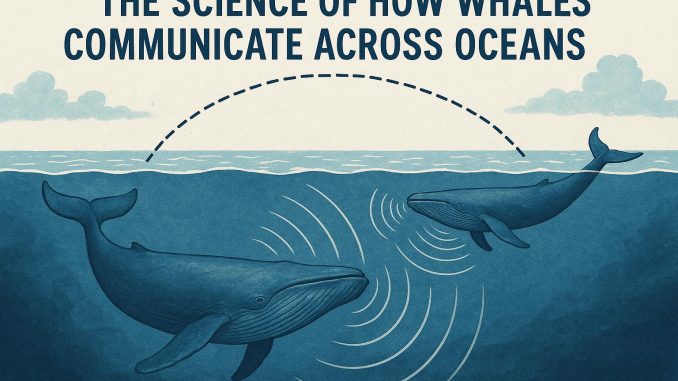
Whales are remarkable creatures that have adapted to life in the vast oceans where communication can be especially challenging due to the expansive and three-dimensional nature of the marine environment. Despite these challenges, whales have developed an intricate communication system that allows them to interact with each other across great oceanic distances.
The Mechanics of Whale Communication
The foundation of whale communication is sound. Due to the efficient propagation of sound through water, whales have evolved to rely heavily on various vocalizations to convey messages, fulfill social functions, navigate their extensive territories, and facilitate hunting. The speed and range of sound transmission in water, which is significantly faster and more expansive than that through air, make it an ideal medium for these marine mammals.
Types of Whale Sounds
The sounds produced by whales are diverse and can be categorized into three main types, each serving distinct purposes:
Clicks: These are primarily employed for echolocation, allowing whales to navigate their environment and locate prey. Toothed whales, such as dolphins and sperm whales, predominantly utilize this form of sound for hunting and orientation within their aquatic surroundings.
Whistles: These frequency-modulated sounds are mainly used by smaller odontocetes, or toothed whales, for communication within groups. Whistles play a critical role in social interactions and maintaining cohesion among individual members of a pod.
Songs: Known for their complexity and beauty, songs are particularly associated with humpback whales. These vocalizations are believed to be part of mating rituals and can convey a variety of information between individuals. Humpback whale songs are intricate, with patterns that can change and evolve over time.
Sound Propagation in Water
The ocean environment is unique in its ability to facilitate the transmission of sound over extensive distances. Certain species of whales have the capacity to communicate across hundreds or even thousands of kilometers due to several factors that influence sound travel. Water temperature, salinity, and depth all play crucial roles in the propagation of sound. Notably, low-frequency sounds, which baleen whales often use, can travel much farther than high-frequency sounds, which are typically employed by other marine creatures.
Cultural Transmission of Song Patterns
One of the fascinating aspects of whale communication is the cultural transmission of song patterns. In species like the humpback whale, these patterns are not only instinctual but are also learned and culturally inherited. This indicates that whales are capable of social learning and adaptation over time, with changes in song patterns reflecting shifts in social structures, environmental conditions, or population movements.
Research and Technological Advancements
The exploration of whale communication continues to advance thanks to modern technology. Scientists employ tools such as hydrophones, which are underwater microphones, and computer modeling to study and analyze the nuances of these vocalizations. This research contributes significantly to our understanding of whale behavior, cognition, and social structures. Moreover, these scientific contributions can aid conservation efforts by providing insights into how human activities affect these marine giants.
Conservation Implications
The study of whale communication has profound implications for conservation, especially in terms of mitigating the impacts of human-induced noise pollution in the ocean. Shipping traffic, industrial activities, and other sources of noise pollution can disrupt whale communication, with potential adverse effects on their natural behaviors and survival. By understanding the nuances of whale vocalizations, effective strategies can be developed to minimize the impact of noise and preserve these majestic creatures.
Further Exploration
For those who are eager to learn more about the intricate world of whales, many research institutions and organizations dedicate themselves to marine research. These entities regularly publish their findings in scientific journals and on their websites, offering valuable insights, tools, and updates on ongoing projects. As research into these marine giants progresses, it continues to unveil the mysteries of our oceans and the natural wonders that reside beneath the waves.
The study of whale communication not only broadens our understanding of marine life but also underscores the importance of maintaining a healthy and balanced environment where such incredible phenomena can continue to occur. Whales, with their complex communication systems and social structures, remind us of the wonders that exist beneath the ocean’s surface and the need to protect these largely unseen ecosystems for future generations.