
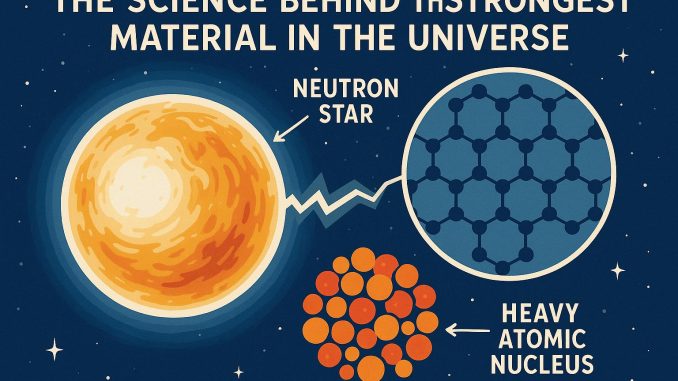
The Search for the Universe’s Strongest Material
The ever-expanding universe is rife with diverse and fascinating materials. Among them, scientists have long been intrigued by substances that exhibit extraordinary strength. Understanding these materials can offer insights not just into the physical universe but also into potential practical applications here on Earth.
Discovering the Properties
To say a material is the “strongest” involves understanding several key properties. The primary focus often lies on tensile strength, the ability of a material to withstand tension without breaking. However, other factors like compressive strength and shear strength also play significant roles.
One of the strongest substances known is nuclear pasta, found in the crusts of neutron stars. These are remnants of massive stars that have exploded in supernovae, leaving behind incredibly dense cores. The nickname “nuclear pasta” derives from the way subatomic particles in these environments resemble pasta-like shapes such as spaghetti and lasagna.
The Role of Density
The extreme density of neutron stars is crucial in forming nuclear pasta. Gravity in these stars is so intense that it compresses matter to densities exceeding that of an atomic nucleus. This results in material so strong that it’s almost impossible to replicate or adequately measure outside of its natural context.
The remarkable density plays a pivotal role not just in the formation but also in understanding the physical characteristics of nuclear pasta. This density magnifies the gravitational forces in action, enabling scientists to appreciate the robustness of materials that can withstand such colossal intensity. Therefore, studying neutron stars becomes more than just an astronomical interest; it becomes a key to accessing the secrets of these enormously strong materials.
Potential Applications
While it’s unlikely that nuclear pasta can be harnessed directly, understanding its properties might inform scientists about material science fundamentals. Theoretical study allows us to explore new ways of constructing strong materials using synthetic processes. Moreover, these insights could potentially impact fields such as materials engineering, where high-strength materials are constantly in demand.
The practical applications of materials inspired by nuclear pasta extend across various fields. Among the possibilities is the electronics industry, where stronger materials could lead to the development of more robust devices that are resistant to external pressures and damages. Aerospace technology also stands to benefit immensely by utilizing high-strength composites to construct lighter yet stronger vehicles. Additionally, such advancements could revolutionize construction techniques, leading to the development of sturdier and more durable infrastructure.
Insights for Theoretical Physics
The implications of discovering and studying such materials also expand into theoretical physics, where models of neutron star behavior can be further refined. This could pave the way for advancements in our comprehension of cosmic phenomena such as gravitational waves.
These remarkable materials not only contribute to our understanding of materials science but also enhance our grasp of the theoretical foundations that govern our universe. By examining nuclear pasta and the extraordinary conditions in which it exists, theoretical physicists can gain insights into the behavior of matter under extreme conditions, which informs and complements our understanding of phenomena like black holes and neutron star collisions.
Theoretical and Practical Challenges
The study of potentially the universe’s strongest material involves numerous theoretical challenges. Simulations and laboratory experiments must attempt to mimic the high-pressure environments of neutron stars, a feat that stretches current technological limits. Researchers are continually developing more sophisticated models and techniques to better approximate these extreme conditions.
One of the primary challenges is developing the technology capable of replicating the extreme pressures and densities found in neutron stars. As scientists endeavor to replicate the environmental conditions required to study nuclear pasta on Earth, innovative approaches in laboratory technology and computational simulations are being explored. These efforts aim to unlock the secrets of the strength inherent within neutron star crusts.
While complexities persist, the journey towards understanding nuclear pasta continues to drive innovation in scientific research. Although direct practical applications may still be out of reach, the quest for knowledge propels scientific understanding forward, opening doors to a deeper awareness of the cosmos and the materials that define it.
Continuing the Quest for Knowledge
The search for the universe’s strongest materials remains an ongoing quest, merging theories from physics, astronomy, and engineering. This interdisciplinary approach is essential as scientists continue to push boundaries and strive to understand materials that once seemed beyond grasp.
Fostering collaborations among experts across these fields can lead to breakthroughs that not only further our comprehension of the universe but also contribute to technological progress on Earth. As research efforts continue, the potential to unlock practical applications from these findings becomes more attainable.
In conclusion, the exploration of the universe’s strongest materials, such as nuclear pasta, presents opportunities for enriching our understanding of the cosmos while also offering potential pathways for innovations in materials science. Through ongoing research and collaboration, the mysteries of these materials may one day contribute significantly to advancements both in space and on Earth.