
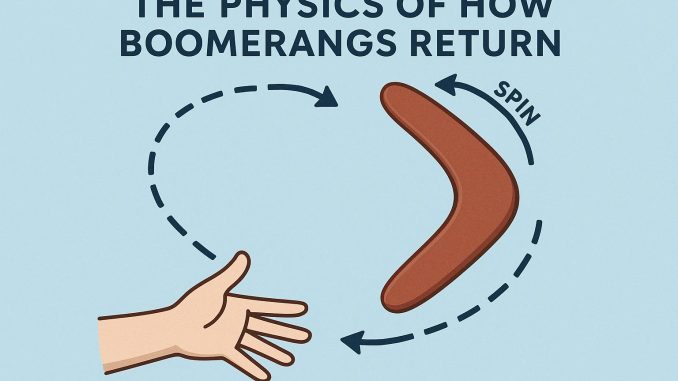
The Mechanics Behind Boomerang Flight
In understanding how boomerangs return to their thrower, it’s essential to first decipher the underlying physics. Boomerangs appear to defy gravity and logic with their curving trajectories, yet their behavior can be explained through principles of physics. Exploring the dynamics that govern these fascinating tools reveals a complex interplay of aerodynamic forces and momentum.
Basic Structure and Design
Boomerangs typically have two or more wings connected at an angle, forming a specific aerodynamic shape. This configuration is not just for aesthetic appeal but for aerodynamic functionality. The classic boomerang design allows it to generate lift as it spins through the air. This lift is akin to the principles that allow aircraft wings to fly, a concept many may be familiar with. However, what sets boomerangs apart is their unique flight path, designed to ensure a returning motion. The asymmetrical shape and the specific orientation of the wings are pivotal in enabling this characteristic flight behavior.
Aerodynamics and Lift
When a boomerang is thrown with a spinning motion, each wing cuts through the air at different speeds. The top wing moves with the direction of the throw, traveling faster, while the bottom wing moves against it and travels slower. This speed differential creates a situation where one wing experiences more lift than the other. Much like how a helicopter’s rotor blade generates lift differently on either side, a boomerang is affected by this uneven distribution of lift. The phenomenon, known as gyroscopic precession, causes the boomerang to turn in flight, making the returning arc a reality.
The Role of Angular Momentum
Angular momentum is an essential factor in the boomerang’s flight. As the boomerang spins, it maintains stability due to this momentum, which helps it to travel in a curved path. Just like a spinning top maintains its balance through the conservation of angular momentum, a spinning boomerang remains steady. The precession effect alters the direction of this path, causing the boomerang to return to its thrower. Without angular momentum, the boomerang would topple over, unable to sustain the elegant return journey that captivates throwers worldwide.
Influence of Air Resistance
Air resistance, or drag, also plays a critical role. As a boomerang moves through the air, drag slows it down and further curves its path. The combination of lift generated by the angled wings and the drag in the opposite direction results in a net force that guides the boomerang on a returning trajectory. The gradual reduction in speed imparts a gentle arc to its flight, pivotal for a precise return. In real-world conditions, variations in wind speed and direction can also influence this drag, challenging throwers to adjust their technique accordingly.
Practical Tips for Throwing
The forces described manifest themselves effectively only if the boomerang is thrown correctly. The ideal throw is overhand, with a snap of the wrist to impart spin. Observing skilled throwers, one notes the smooth transition from arm motion to wrist flick, akin to a professional baseball pitch, channeling energy efficiently from the body into the device. The angle of release and the amount of force used will vary depending on the specific design and size of the boomerang. Precision in these variables translates to flight accuracy. Different boomerangs, be it traditional wooden designs or modern, lightweight materials, may require slight adjustments to the throwing technique. Understanding and experimenting with these variables can enhance the accuracy of the returning flight. Enthusiasts often refine their skills over time through practice and meticulous observation of each throw’s outcome.
Historical and Cultural Context
Boomerangs hold significant value in various cultures, most notably among Indigenous Australians, where they have been used for hunting and as ceremonial objects for thousands of years. The historically crafted designs varied in size, shape, and use, some even designed specifically not to return. Understanding this evolution adds a rich layer to the appreciation of modern boomerang mechanics. Today, they are not only tools of sport and leisure but carry a legacy of innovation and cultural significance.
Conclusion
The returning flight of a boomerang is a fascinating demonstration of aerodynamics, angular momentum, and gyroscopic precession in action. While the mathematics and physics underlying its motion may be complex, these elements collectively ensure that the boomerang behaves not just as a tool of play but also as a subject of scientific interest. The allure of its mystifying return combined with the satisfaction of mastering its flight renders it a perennial subject of curiosity. For those keen to delve deeper into the science of flight, numerous resources and research papers can offer more comprehensive insights into the intriguing world of boomerangs. As one explores further, the simplicity of the boomerang’s construction contrasts beautifully with the complexity of the physics at play, promising endless learning and engagement.