
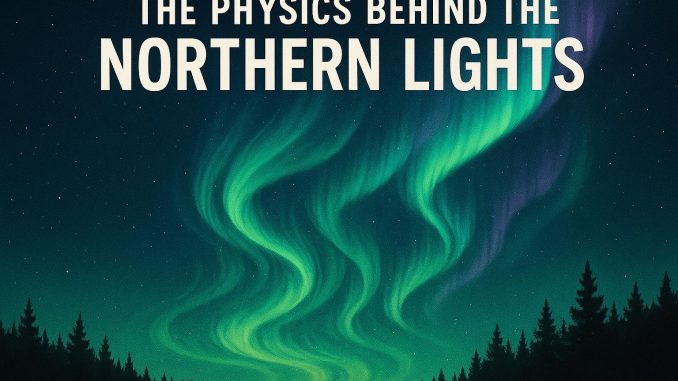
The Phenomenon of the Northern Lights
The Northern Lights, scientifically referred to as the Aurora Borealis, represent a fascinating natural light display that can predominantly be observed in the high-latitude regions, particularly encircling the Arctic and Antarctic circles. This luminescent display continues to garner significant interest because of its vivid and enchanting colors that sweep across the darkened sky in an ethereal dance. The vibrant hues and majestic movements of these lights have inspired countless myths, legends, and studies over centuries. While the visual spectacle itself is enthralling, delving into the physics that underpin this phenomenon can enhance the appreciation and understanding of this natural occurrence.
Origins of the Northern Lights
The origins of the Northern Lights are steeped in the interactions between charged particles emitted by the Sun, known as the solar wind, and the Earth’s magnetosphere. The solar wind consists mainly of electrons and protons continuously being emitted by the Sun. Upon reaching the Earth, these charged particles can become ensnared within the magnetosphere. This magnetosphere acts as a protective bubble constituted by magnetic fields that safeguard the planet from various cosmic and solar particles.
The Role of the Earth’s Magnetic Field
The Earth’s magnetic field is integral in determining the formation, shape, and location of the Northern Lights. This geomagnetic field guides the solar wind particles toward the polar regions, where the magnetic field lines converge. As these charged particles make their descent into the upper atmosphere, they interact with gas molecules. This collision and subsequent excitation of gas molecules result in the beautiful and vivid colors characteristic of the auroras.
Color Production in the Aurora
The array of colors observed in the Northern Lights—predominantly greens, reds, blues, and purples—are the result of specific interactions between the solar particles and various gas molecules present in the Earth’s atmosphere.
Oxygen molecules are fundamental in producing the most commonly seen colors in auroras. When these molecules are excited by solar wind particles, they can emit green light, typically visible at altitudes ranging from 100 to 300 kilometers above the Earth. In some instances, they may also emit red light, although this is less common and usually observed at higher altitudes. Notably, green is recognized as the most prevalent color seen during auroral displays.
Nitrogen molecules also contribute to the color palette, responsible for producing blue or purplish-red hues. The presence of blue and purple colors often correlates with interactions taking place at lower altitudes, showing the complexity of processes at work during an auroral display.
Impact of Solar Activity
The intensity and frequency with which the Northern Lights occur are closely tied to the level of solar activity. Enhancements in solar activity, such as solar flares and coronal mass ejections, can lead to a greater number of particles being dispatched from the Sun, translating into auroras that are more vibrant and frequent. This interplay between solar activity and the Northern Lights forms a part of the broader solar cycle. This cycle lasts approximately 11 years, characterized by varying stages of solar activity that alternately rise and fall.
For individuals eager to witness this magnificent phenomenon firsthand, traveling to high-latitude regions during the winter months is essential, when the nights are longest, and the skies are darkest, affording the best opportunities to witness the auroras’ full glory. Nevertheless, the allure of the Northern Lights is not confined to a visual experience alone. It stands as a profound illustration of the harmonious interplay between solar activity and the terrestrial processes that support life on Earth.
For further exploration of the intricacies of solar activity and its influence on the Northern Lights, resources from reputable institutions such as the National Aeronautics and Space Administration (NASA) or the Space Weather Prediction Center serve as excellent repositories of extensive data and insights into ongoing solar and magnetospheric interactions.
Understanding the scientific mechanics behind the Northern Lights introduces a layer of complexity yet deepens the intrigue that this celestial phenomenon consistently provokes. The cosmic dance of particles not only adorns our night skies with ephemeral beauty but also tells a story of interactions on a vast scale—a story that transcends human history, compelling generations to look skyward in wonder and curiosity. The Northern Lights, thus, persist as not only a subject of aesthetic admiration but also as a scientific marvel, bridging the realms of natural beauty and cosmic understanding.
Moreover, appreciating the broader implications of these interactions fuels ongoing scientific exploration and monitoring of space weather phenomena, which have critical implications for satellite operations, communication systems, and even power grids on Earth. The study of auroras, therefore, continues to be of paramount importance not only for understanding our own planet’s atmospheric phenomena but also for safeguarding the technologies that form an indispensable part of modern existence.