
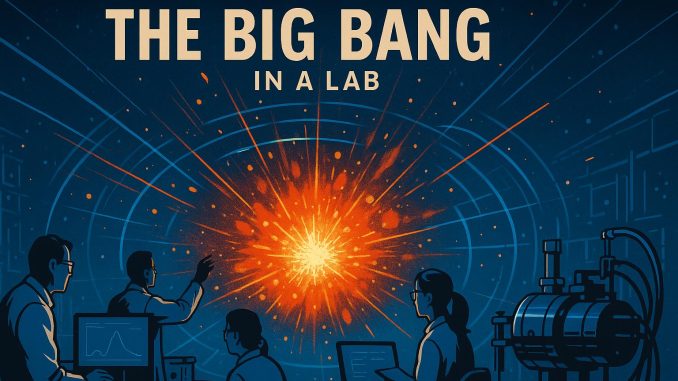
Introduction to Big Bang Recreation
Scientists have developed advanced methods to simulate conditions similar to those that occurred during the Big Bang. These experiments are carried out in laboratories equipped with highly sophisticated technology, offering valuable insights into the universe’s origin and evolution. The recreation of these initial cosmic conditions serves as a foundation for understanding how all matter and forces originated. By unlocking the secrets of the cosmos, scientists aim to enhance our comprehension of the fundamental laws governing the universe.
The Role of Particle Colliders
At the heart of recreating the Big Bang’s conditions in a controlled environment is the use of particle colliders. The Large Hadron Collider (LHC), one of the most prominent and largest research instruments, is pivotal in this exploration. The LHC resides at the European Organization for Nuclear Research, known as CERN. It represents the frontier of technology and physics research, accelerating protons to speeds approaching the speed of light and subsequently colliding them with each other. These high-energy collisions mimic the intense energy levels thought to have existed moments following the Big Bang. The resulting data allows scientists to probe the nature of physical laws at the most fundamental level.
Understanding Quark-Gluon Plasma
The experiments conducted in colliders such as the LHC allow researchers to focus on replicating a state of matter known as quark-gluon plasma. This phase of matter, characterized by free quarks and gluons, is believed to have dominated the universe just microseconds after the Big Bang. When particle collisions reach extreme energy thresholds, a transient formation of quark-gluon plasma can occur. By studying this plasma, researchers strive to unravel the mysteries of the universe’s early moments, investigating how it cooled and transitioned from a hot, dense state to its current more stable form.
The Search for Higgs Boson
The discovery of the Higgs boson in 2012 stands as a monumental achievement in particle physics, marking a significant leap in our understanding of the universe. This particle plays a crucial role in the mechanism that imparts mass to other particles, a process integral to the formation of the universe as we perceive it. While the Higgs boson experiments aren’t direct attempts to recreate the Big Bang, insights gained from these experiments offer invaluable information about the universe’s infancy. Analyzing properties of the Higgs boson helps illuminate the forces and particles pivotal during the Big Bang, enhancing our grasp of cosmological evolution.
Applications and Future Research
Beyond illuminating the origins of the cosmos, simulating Big Bang conditions bears profound implications for numerous scientific frontiers. These experiments advance our understanding of fundamental forces, such as electromagnetism and nuclear forces, potentially leading to significant refinements of existing physical theories. Moreover, they pave the way for exploring phenomenon that defy current scientific knowledge, hinting at new physics beyond the prevailing models.
Future research endeavors, furnished by ever-evolving theoretical advancements and technological innovations, aspire to explore deeper uncharted territories of particle physics. As instrumentation becomes more precise, scientists anticipate uncovering new phenomena that could revolutionize scientific paradigms. By simulating the universe’s earliest moments, researchers extend our comprehension of the natural world, laying the groundwork for groundbreaking discoveries. This continuous probing of nature’s frontiers not only augments our understanding of the past but propels the potential for future advancements in theoretical and applied physics.
In pursuing the recreation of Big Bang conditions, scientists are tackling one of the most challenging and profound questions in the study of the universe. This ongoing research highlights a quest that transcends specific discoveries, embodying the relentless human drive to understand the cosmos and our place within it.