
Introduction to Echolocation
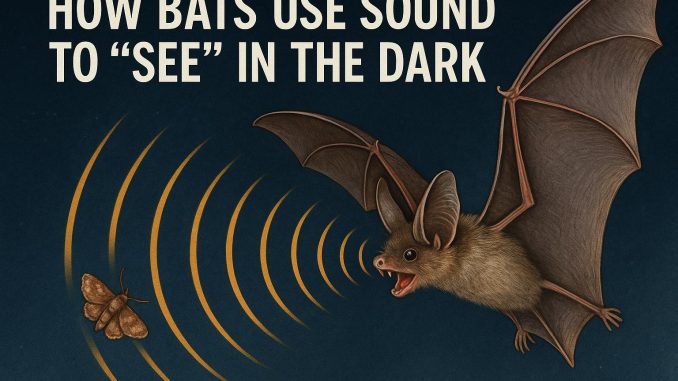
Bats are fascinating creatures that have evolved an extraordinary method of navigating in the dark. Known as echolocation, this process allows bats to “see” through the use of sound waves. While many animals rely on vision, bats have adapted to thrive in environments where light is scarce.
Understanding Echolocation
Echolocation is a technique that some animals use to locate objects by emitting sounds and listening for the echoes that bounce back from those objects. This allows bats to determine the size, shape, distance, and movement of their surroundings.
Generating Sound Waves: Bats emit sound waves from their mouth or nose. These sounds are often at frequencies too high for the human ear to detect, known as ultrasound.
Receiving Echoes: When the sound waves hit an object, they produce echoes. Bats have highly sensitive ears capable of picking up these echoes, allowing them to build a mental map of their surroundings.
How Bats Process Information
Bats possess an advanced auditory system that lets them process echoes with impressive speed and accuracy. The time it takes for the echo to return informs the bat about the distance of the object. The direction from which the echo originates helps the bat determine the object’s location. Any changes in the frequency of the returning sound waves, due to the Doppler effect, provide information about the object’s movement.
The Biology Behind Echolocation
The physiology of bats plays a crucial role in their echolocation abilities. Their larynx is specially adapted to produce high-frequency sounds. In addition, the facial structure of bats, often including a nose leaf in certain species, acts as a directional funnel for sound emission. The adaptations extend to their auditory cortex, where neural mechanisms have evolved to precisely interpret the intricate details carried by echoes. This seamless integration of anatomical features and sensory processing underscores the evolutionary ingenuity of bats.
Doppler Effect in Echolocation
The Doppler effect is an important aspect of bat echolocation. As bats move towards or away from an object, the frequency of the returning sound waves changes. Bats can interpret these frequency changes to assess how fast an object is moving and in which direction.
Applications and Research in Echolocation
The study of echolocation is not only vital for understanding bats but also offers groundbreaking insights in various fields. Researchers studying echolocation aim to unravel the intricacies of neural processing in bats, which could further the development of advanced auditory prosthetics for humans.
Moreover, engineers and scientists take inspiration from echolocation for designing sonar systems, commonly used in submarines and maritime navigation. Furthermore, acoustic imaging techniques, used in medical diagnostics and geological exploration, also trace their conceptual roots back to the principles of echolocation. Exploring how bats utilize sound to ‘see’ expands our understanding of sensory systems and can inspire innovative solutions to technological challenges.
Comparative Analysis with Other Echolocating Animals
Echolocation is not exclusive to bats; other animal species have also evolved this capability, although to varying extents and with different adaptations. Dolphins and certain species of birds, such as oilbirds and swiftlets, employ similar methods to navigate and hunt. Unlike bats, which emit sounds through their noses or mouths, dolphins use the melons in their foreheads to focus acoustic signals.
The comparison between these species enhances the collective understanding of echolocation as a biological phenomenon. Such studies delve into the convergent evolution of this trait, revealing the multifaceted ways through which echolocation manifests across the animal kingdom.
Challenges in Echolocation
Despite its advantages, echolocation comes with its own set of challenges. The reliance on sound can be a limitation in environments cluttered with obstacles or in densely populated bat colonies, where acoustic interference might occur. Bats must, therefore, fine-tune their echolocation calls in terms of frequency, intensity, and time intervals to mitigate these challenges.
Moreover, the energetically expensive task of producing echolocation calls necessitates efficient energy management within these creatures. During periods of resource scarcity, such as in colder months when insects are less abundant, this energy balance becomes critically important. The adaptability and resilience of bats in managing these constraints further highlight the complexities of echolocation.
Conclusion
Echolocation is a remarkable adaptation that allows bats to excel in their nocturnal environments. This capability not only assists them in hunting and navigation but also offers an interesting dimension to the study of animal behavior and biological sciences. Understanding this biological sonar system not only informs us about bats but also inspires technological advancements in human devices, such as sonar and acoustic imaging systems.
As research continues to unfold the layers of echolocation, it underscores the marvel of evolutionary processes that equip living beings to survive and thrive in various ecological niches. The quiet, yet profound, journey of echolocation—from enigmatic bat chants to revolutionary technologies—emphasizes the intricate balance of nature, where every sound holds a story and every echo is a lesson.