
Understanding Echolocation in Dolphins
Dolphins are renowned for their intelligence and social behavior, but their use of echolocation stands out as a particularly fascinating aspect of their abilities. This biological sonar system enables dolphins to navigate, hunt, and communicate underwater.
What is Echolocation?
Echolocation is a method used by certain animals to locate objects by producing sound waves and interpreting the echoes returned after those waves bounce off objects. It is an effective navigation tool, especially in murky waters where visibility is low. Dolphins rely on this technique to understand their environment with remarkable precision.
How Do Dolphins Produce and Receive Echolocation Clicks?
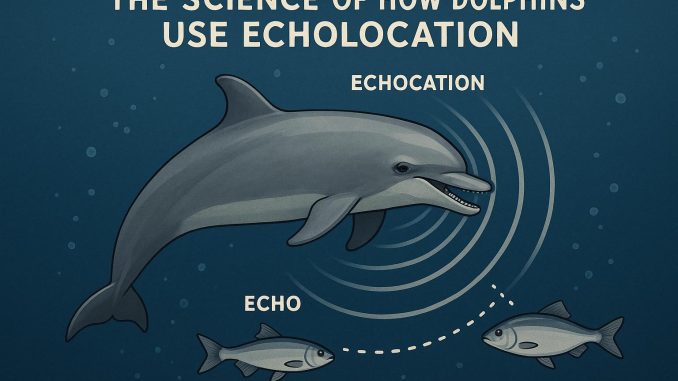
Dolphins generate sound waves, known as clicks, using specialized organs located in their heads. The process begins in the nasal sacs situated just beneath their blowholes. As air moves through these sacs, clicks are produced and then focused through the melon, a fatty structure on the dolphin’s forehead. The melon acts as an acoustic lens, directing the sound waves into the water.
Upon hitting an object, these sound waves return as echoes. Dolphins receive these echoes through their jawbones, which are connected to their inner ears. This enables them to effectively interpret the size, shape, distance, speed, and even material of the objects around them.
The Science Behind Echolocation
Research has shown that dolphins produce clicks at varying frequencies, which allows them to detect objects of different sizes and at different ranges. Higher frequency clicks provide more detail and are useful for examining nearby objects, while lower frequencies travel further, aiding in long-distance navigation.
The ability to differentiate between these frequencies is crucial for dolphins as they navigate through their complex underwater world. This echolocation ability is so acute that dolphins can detect the presence of small fish even amidst dense schools.
The Evolutionary Advantage
Echolocation offers dolphins a significant evolutionary advantage, particularly in their aquatic environment where sound travels faster and further than light. This ability enhances their hunting efficiency, social interaction, and overall survival.
Through extensive studies, scientists have further understood the roles of echolocation in the dolphin community. These insights not only highlight the intricacies of marine life but also inspire technological innovations in sonar and navigation systems for human use.
Nuances of the Echolocation Process
The sophistication of dolphin echolocation is evident in the refined auditory processing abilities that facilitate this biological sonar system. The sheer speed at which dolphins interpret echolocation signals demonstrates an advanced level of neurological processing. From the moment clicks are emitted, to the instant echoes are interpreted, dolphins perform a rapid and precise analysis of the information received. Sound waves reflected from objects provide immediate feedback on the structural characteristics of those objects.
Dolphin Communication and Echolocation
Beyond navigation and hunting, echolocation plays a critical role in dolphin communication. Dolphins have been observed using their echolocation capabilities during social interactions, suggesting that this system might contribute to their complex social structures. Dolphins can potentially communicate their experiences with objects in their environment through the use of echolocation signals, which might carry specific information meaningful to other dolphins.
Furthermore, communication through echolocation allows dolphins to share vital information, such as the presence of predators or the availability of food sources. The dynamic use of echolocation in social settings indicates a profound level of cognitive function and adaptability.
Technological and Environmental Implications
The study of echolocation in dolphins not only expands our understanding of these intelligent animals, but it also provides practical implications for technology. By mimicking this natural sonar, innovations have been developed in various fields. From enhancing underwater sonar systems to designing more efficient ways to navigate difficult terrains, the applications of echolocation-inspired technologies are vast.
Additionally, understanding dolphin echolocation offers insights into how sound pollution might affect marine life. Human activities contribute to ocean noise levels, potentially disrupting dolphin echolocation capabilities. As dolphins rely heavily on sound for survival, it’s crucial that efforts are made to mitigate these impacts and preserve marine habitats.
Future Directions in Echolocation Research
Research on dolphin echolocation continues to evolve, encompassing various disciplinary approaches such as biology, engineering, and environmental science. Current studies aim to further unravel how echolocation is fine-tuned among individuals within dolphin pods, investigating whether certain groups have specialized echolocation techniques.
Moreover, understanding the neurological underpinnings of echolocation processing in dolphins remains a key focus area. Insights into how dolphins process complex auditory information could shed light on broader questions about brain function and cognition.
Furthermore, ongoing research into the effects of environmental changes on echolocation efficiency could inform conservation strategies aimed at protecting both dolphins and their ecosystems. Scientists are particularly interested in how factors such as climate change, water pollution, and habitat destruction might alter the efficacy of echolocation in dolphins.
Conclusion
Through advanced echolocation abilities, dolphins navigate their world with precision, exemplifying the wonders of adaptation and evolution. This natural sonar not only underscores the intelligence of these marine mammals but also inspires human innovation. As we continue to study these fascinating creatures, we gain deeper insights into both biological complexity and our own potential for technological advancement. The interplay between dolphins and their acoustic environment offers a rich tapestry of discovery, beckoning us to explore new realms of scientific inquiry and conservation.