
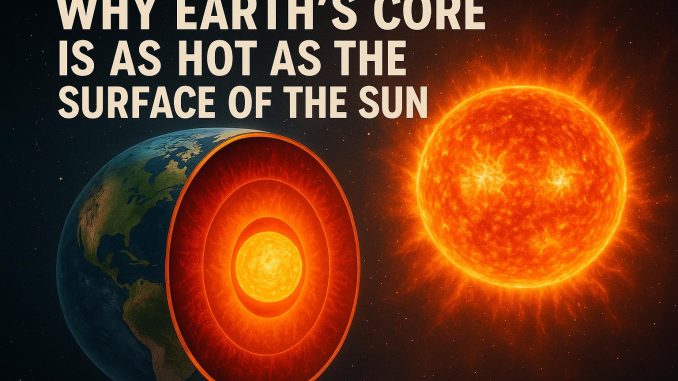
Understanding Earth’s Core Temperature
The Earth’s core, lying deep beneath its surface, boasts temperatures that can be surprisingly similar to those found on the surface of the Sun. This intriguing fact arises from scientific studies that employ a blend of geological observations and theoretical calculations to understand the core’s composition and its thermal behavior. Present-day estimates consistently indicate that the Earth’s core can reach temperatures up to 9,000 degrees Fahrenheit, or around 5,000 degrees Celsius, a value remarkably close to the temperature of the Sun’s outermost layer.
Composition and Heat Sources
The Earth’s core’s composition primarily consists of iron and nickel, metals renowned for their efficient heat conduction properties. This heat retention is pivotal to maintaining the core’s high temperatures. The persistence of such heat is attributable to several overlapping factors:
Gravitational Pressure: A key factor is the immense pressure exerted by the Earth’s mass, bearing down on itself. This pressure contributes significantly to sustaining high temperatures, as the deep core remains heated under the immense weight of the planet’s overlying layers.
Radioactive Decay: Another contributor is the decay of radioactive isotopes, notably uranium and thorium, which generate heat. This decay process acts as a constant heat source, helping maintain the core’s elevated temperatures over the overarching spans of geological time.
Residual Heat: Additionally, a portion of the core’s heat is believed to be residual energy left over from the time of the Earth’s formation. During its formative stages, the Earth accumulated mass through a process known as accretion, which released substantial amounts of energy, some of which persists in the core even today.
Comparisons with Stellar Temperatures
The temperature within the Earth’s core often draws comparisons to that of the Sun, particularly its surface. While it may seem counterintuitive for a terrestrial body like Earth to harbor a core as hot as the Sun’s surface, it is a valid scientific marvel. Unlike the Sun, where nuclear fusion is the primary heat-generation mechanism (transforming hydrogen into helium), the Earth’s core lacks such fusion processes. Instead, it relies on gravitational pressure and the heat sources previously detailed to maintain its elevated temperatures. Despite the absence of fusion, these factors are potent enough to bring the core’s temperature in line with that of the Sun’s surface.
Measuring the Temperature
Exploring and measuring the Earth’s core’s temperature is an intricate endeavor, given the depth and extreme conditions. Direct measurement is not feasible with current technology, necessitating alternative scientific methods. Instead, scientists rely on seismic wave data and advanced simulations to deduce the core’s thermal properties.
For instance, seismic waves, which are generated by natural phenomena such as earthquakes, serve as a primary tool for analysis. Researchers track how these waves traverse different layers of the Earth, noting variations in speed and refraction. These observations enable scientists to make educated inferences regarding the core’s structure and temperature, offering invaluable insights into the Earth’s deep interior.
Implications for Earth Sciences
A thorough understanding of the Earth’s core temperature has profound implications for various scientific fields, particularly geology and geophysics. The knowledge helps provide clarity on the dynamics of many geological phenomena.
For example, the dynamo effect within the Earth’s liquid outer core—a process that generates the planet’s geomagnetic field—relies heavily on the core’s heat dynamics. Similarly, volcanic activity, often driven by mantle plumes originating near or at the core, provides dramatic evidence of the thermal processes at play within the planet.
Further, understanding the core’s temperature and behavior assists geophysicists in modeling Earth’s tectonic activities, predicting volcanic eruptions, and assessing risks such as earthquakes. These insights are crucial for designing measures to mitigate natural disasters and understand the long-term evolution of Earth’s geological features.
For those keen on delving deeper into Earth’s geothermal dynamics, a wealth of information awaits from leading scientific entities like Stanford University and NASA. These organizations not only advance research but also strive to communicate complex geological processes to the public, enriching our collective comprehension of this dynamic planet.
In sum, while the spectacle of the Earth’s core temperature reaching levels akin to the Sun might seem extraordinary, it is a testament to the intricate and fascinating processes that govern our planet. This understanding unveils not only Earth’s formidable nature but also the role it plays in sustaining the diverse life forms that inhabit its surface.