
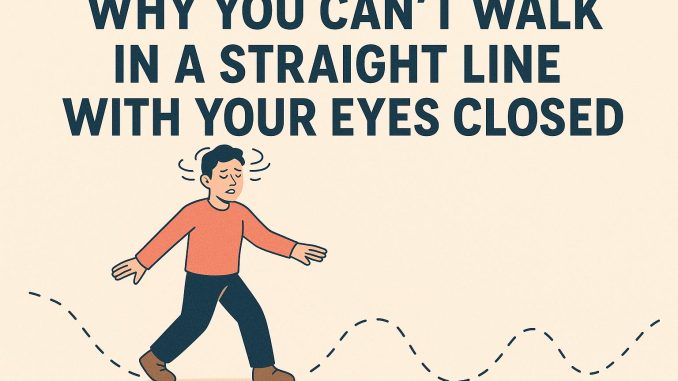
The Mystery of Walking in a Straight Line with Eyes Closed
Humans generally find it challenging to walk in a straight line when their eyes are closed. This phenomenon, while seemingly trivial, is a topic of curiosity that has intrigued scientists for some time. The reasons behind this difficulty are rooted in how our bodies perceive and orient themselves in space.
Sensory Inputs and Spatial Awareness
The human body’s ability to move in a straight line is largely dependent on sensory inputs. When we walk, we use a combination of visual, vestibular, and proprioceptive inputs to determine our direction.
Visual Input: The eyes play a crucial role in maintaining a straight path by providing constant feedback about our position relative to our environment. Without visual cues, our brain struggles to maintain a straightforward trajectory. Visual information is paramount in shaping our understanding of space and direction. This is why when we close our eyes, we are deprived of an essential tool that helps in spatial navigation. The absence of visual stimuli leads to a decreased ability to correct minor displacements, thus drifting off a straight path becomes inevitable.
Vestibular System: Located in the inner ear, the vestibular system helps control balance and spatial orientation. It is responsible for tracking head movements and transmitting this information to the brain. In the broader sense, it acts as the body’s natural gyroscope. When the eyes are closed, the vestibular system attempts to compensate, but it cannot entirely fill the gap left by the lack of visual input. This system excels in rapid head movements and intricate balance tasks; however, it is less effective in maintaining directional continuity for ambulation without vision.
Proprioception: This is the body’s ability to sense its own position in space. Proprioception is a marvelous sensor, allowing us, even with eyes closed, to touch our nose with a finger. Despite its utility in understanding body dynamics, rather than relying on visual input, it is not always accurate enough to keep someone walking in perfect alignment. Minor inaccuracies in proprioceptive feedback can accumulate over distance, resulting in deviations from a straight line.
The Role of Asymmetries and Bias
Natural Body Asymmetries: Most humans are not perfectly symmetrical. Subtle differences in leg strength or length can cause uneven propulsion, leading an individual to deviate from a straight line. These asymmetries might not be noticeable during normal activities because the visual system offers continuous feedback for correction. However, with eyes closed, it becomes more apparent—causing one leg to push slightly harder or farther than the other, gradually resulting in a curved path.
Cognitive Bias: Even without conscious awareness, most people have a natural tendency to veer slightly to the right or left. This bias can become pronounced when visual checks are absent. Our brains are wired in unique ways, with lateral preferences playing a part in directional biases. This cognitive inclination makes it harder to maintain a consistent path without visual affirmation, exacerbating the deviations caused by physical asymmetries.
Scientific Studies and Observations
Research conducted on the subject shows that people tend to walk in circles or veer off course when deprived of visual feedback. Significant studies in controlled environments confirm that individuals rarely maintain a straight line over substantial distances without the ability to see. These findings not only underscore the importance of visual input but also reveal the intricate connections between various systems involved in spatial orientation.
One such study analyzed the paths taken by participants walking blindfolded and noted consistent deviations that varied among individuals. These deviations are a result of the complex interplay between the aforementioned sensory systems and individual physical characteristics. The diversity in the extent and direction of deviation also highlights the uniqueness of each person’s neurological and physical makeup. Through controlled experiments focusing on the distance covered and the nature of veering, scientists have been able to catalogue and better understand these phenomena, offering insights into the underlying principles of human movement.
Studies on Circular Walking Patterns
In studies where participants were asked to walk in open fields blindfolded, many ended up walking in large circles rather than straight lines. This recurring pattern provides evidence of how slight biases and asymmetries can cumulatively result in circular paths. It reinforces the idea that without external reference points or visual markers, our paths are largely influenced by inherent physical and cognitive tendencies.
The Challenges of Counteracting Drift
Interestingly, attempting to walk in a straight line with your eyes closed can be likened to navigating open seas without a compass. The primary challenge is the absence of visible reference points that prevent the natural drift caused by minor miscalculations in leg movement and balance inputs. Without visual feedback, corrective actions become both delayed and inaccurate, resulting in broader deviations over time.
Conclusion
The inability to walk in a straight line with eyes closed underscores the intricate balance and cooperation between our sensory systems. Understanding this phenomenon not only highlights the complexity of the human body but also conveys the critical importance of visual input in motion and orientation. While it may seem like a simple quirk, this capability—or lack thereof—offers valuable insights into human physiology and perception. This phenomenon of veering while walking without visual aids illustrates not only the specialized roles of various sensory systems but also the extraordinary human reliance on vision for navigation. This reliance is a remarkable testament to how seamlessly integrated and essential these systems are for our day-to-day functions.
The study of this topic does more than just satiate human curiosity; it informs a wide array of practical applications, from improving navigation aids for the visually impaired to expanding our understanding of neurological functions related to mobility and balance. Furthermore, it opens avenues for research in robotics and artificial intelligence, providing a natural analog from which to draw inspiration for the development of non-visual navigation systems.